Kathmandu, Nepal — September 2026
Christine Chilfuya Glidden a member of the Rotary Club of Albuquerque, traveled to Nepal to launch the club's sixth sewing center with partners at the Rudramati Rotary Club of Kathmandu. The project, which also provides washable menstrual kits to girls, is fully funded and has been approved for a grant from The Rotary Foundation, Rotary's charitable arm.
While Christine was in the country, Nepal's glacial floods struck.
A landscape erased
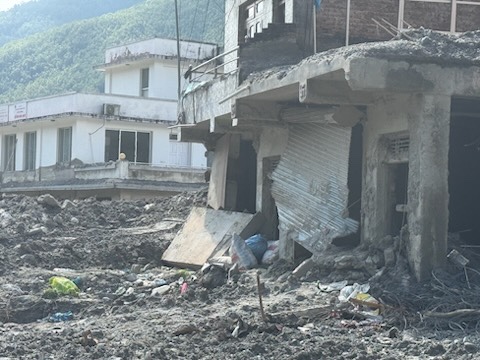
Christine traveled to Nuwakot, a hub for recovery efforts in the flood-affected areas. She described acres of gray mud and rock where homes and shops once stood, with enormous boulders carried downstream now sitting in the middle of former neighborhoods.
Many of the houses still standing are not safe. Lower floors are filled with mud, walls and wiring are exposed, and deep cracks run through foundations. Some families downstream received phone warnings before the flood hit but had only moments to react.
"Imagine a lunar landscape," she wrote. "Acres of gray emptiness, broken only by the remains of homes."
Home insurance is almost nonexistent in the region. Families who lost houses, furniture, photographs and livelihoods will not receive a check to rebuild. Some will spend months clearing debris by hand with buckets and shovels. Others are staying with relatives or living in tents provided by NGOs and the government.
Listening before sending
Rather than shipping supplies based on assumptions, Rotary partners on the ground are asking families what they need. Deepak, a Rotarian working in the affected area, is meeting directly with households. So far, blankets, mattresses and clothing top the list.
Deepak is also overseeing a substantial donation from a Rotary club in Australia, which puts him in a position to respond to what families say they need rather than duplicate what has already arrived. Some items, including school supplies and toiletries, have already come in quantity.
"Good relief work is not simply sending things," [first name] wrote. "It is listening first, avoiding duplication and providing what people actually need."
Where the sewing center project fits
The Albuquerque club's washable menstrual kits are proving useful in the recovery. Disposable products can meet an immediate need, but once those supplies run out, reusable kits keep working. The sewing centers themselves create local skills and income, the kind of lasting capacity communities need long after emergency aid ends.
A moment that stays
During one visit, [first name] sat across a kitchen table from a woman who could not stop crying. She had not lost a family member; she was crying from the trauma of it all. Without a shared language, [first name] reached across the table with her palm up. The woman placed her hand in hers, and they stayed that way for a few moments.
"Compassion did not require translation," [first name] wrote.
The long work ahead
The flood has passed, but the emergency has changed shape. In some areas, children have returned to school, bringing back a small piece of routine. For the families of Nuwakot, the long work of rebuilding homes and lives is just beginning.